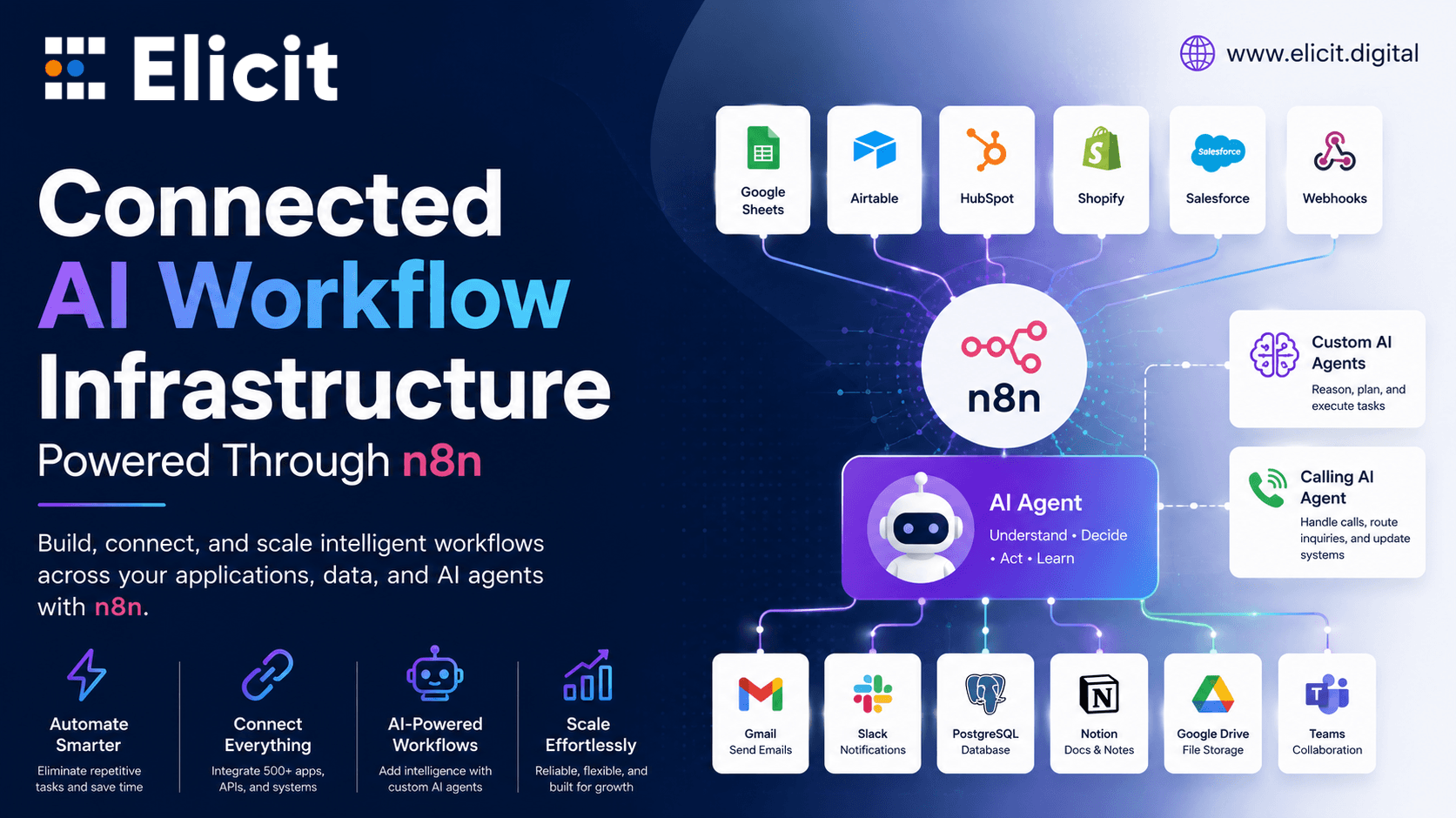
Advanced n8n Workflow Automation: How AI Agents Are Reshaping Customer Operations
Key Takeaways
- Businesses are moving beyond simple automations toward connected operational systems powered by AI and workflow orchestration.
- An advanced n8n workflow can connect CRM systems, customer communication, reporting, internal approvals, and AI-driven actions in one infrastructure layer.
- Customer Automation is becoming a core operational strategy instead of a marketing add-on.
- Calling AI Agent systems and Custom AI Agent workflows are helping businesses improve response speed and operational efficiency.
- Companies investing early in n8n workflow automation are building scalable infrastructure for long-term growth.
Introduction
For a long time, automation inside businesses was relatively simple.
A lead form triggered an email.
A CRM update sent a Slack notification.
A spreadsheet received new entries.
That level of automation helped businesses save time, but it also created a major limitation. Most systems operated independently. They handled isolated tasks rather than connected operations.
Today, that is changing quickly.
Businesses are no longer looking for basic automations alone. They want systems that can coordinate customer communication, internal workflows, CRM activity, reporting, notifications, scheduling, and even AI-driven decision-making in one connected process.
This is exactly why platforms like n8n are becoming more important.
Instead of acting like another standalone automation tool, n8n allows businesses to build operational workflows that connect multiple systems in a much more flexible way.
And as AI continues evolving, that flexibility matters more than ever.
Why Businesses Are Moving Beyond Basic Automation
One of the biggest challenges growing businesses face is operational fragmentation.
A customer inquiry might arrive through a website chatbot, move into a CRM, trigger an internal sales notification, generate a follow-up email, and eventually require manual updates from multiple teams.
The problem is not necessarily the individual tools.
The problem is the disconnect between them.
When workflows rely too heavily on manual coordination, delays start appearing everywhere:
follow-ups happen late, notifications get missed, customer information becomes inconsistent, and operational visibility starts breaking down.
This is where advanced workflow orchestration changes the picture.
An advanced n8n workflow allows businesses to connect these moving parts into a centralized operational process rather than relying on disconnected automations scattered across different platforms.
That creates faster execution, fewer manual errors, and a much smoother customer experience.
AI Agents Are Changing the Role of Automation
One of the biggest shifts happening right now is the rise of AI agents inside operational workflows.
Traditional automation follows fixed instructions.
If X happens, do Y.
AI agents introduce something different.
They can interpret requests, analyze information, trigger workflows, retrieve data, and manage more dynamic operational tasks.
This is why businesses are becoming increasingly interested in Custom AI Agent systems.
Instead of using generic AI tools, companies are starting to build AI workflows designed specifically around their own operations, customer processes, and internal systems.
For example, a business may create an AI agent that can:
-
qualify inbound leads
-
schedule appointments
-
Update CRM records
-
trigger internal notifications
-
escalate urgent support issues
-
answer operational questions
-
generate summaries for sales teams
This moves automation beyond repetitive tasks into intelligent operational coordination.
And that shift is happening much faster than many businesses realize.
Customer Automation Is Becoming Operational Infrastructure
A few years ago, customer automation usually meant simple marketing workflows.
Autoresponders.
Basic email sequences.
Generic chatbot replies.
Now, businesses are building much more connected customer operations systems.
Modern Customer Automation can include:
-
AI-powered lead qualification
-
automated appointment scheduling
-
customer onboarding workflows
-
voice AI response systems
-
CRM routing
-
sales pipeline movement
-
follow-up recovery workflows
-
escalation handling
The goal is no longer just automation.
The goal is operational continuity.
Customers increasingly expect businesses to respond quickly, maintain context, and provide consistent communication across every touchpoint.
Disconnected systems make that difficult.
Connected automation infrastructure makes it possible.
Why n8n Is Growing So Quickly
One reason businesses are increasingly adopting n8n automation is flexibility.
Many automation platforms work well for simple workflows, but become restrictive when operations grow more complex.
n8n allows businesses to create workflows that are highly customizable and deeply connected across APIs, databases, CRMs, AI systems, communication tools, and internal platforms.
That flexibility becomes especially valuable when businesses start building:
-
AI customer response systems
-
advanced CRM automation
-
internal reporting workflows
-
operational approval systems
-
multi-platform lead routing
-
AI-powered scheduling systems
-
customer support automation
Instead of forcing operations into rigid templates, n8n gives businesses more control over how workflows are designed.
That is a major reason why adoption continues growing among companies building more advanced automation systems.
The Rise of Calling AI Agent Systems
Voice AI is becoming one of the fastest-growing areas in automation infrastructure.
Businesses are increasingly experimenting with Calling AI Agent systems capable of handling inbound customer conversations automatically.
These systems can:
-
answer calls
-
collect customer information
-
qualify leads
-
schedule appointments
-
route inquiries
-
trigger CRM updates
-
escalate conversations when needed
But the real value appears when voice AI becomes connected to larger operational workflows.
For example:
A customer call comes in.
The AI agent qualifies the inquiry.
The CRM updates automatically.
A sales notification is triggered.
An appointment is booked.
A follow-up workflow begins immediately.
That level of connected execution creates a significantly smoother customer experience while reducing operational pressure on internal teams.
Operational Friction Quietly Slows Growth
Many businesses underestimate how much operational friction impacts growth.
Simple inefficiencies add up quickly:
-
manual handoffs
-
inconsistent follow-ups
-
repetitive admin tasks
-
disconnected reporting
-
delayed approvals
-
fragmented customer communication
Over time, these small operational problems reduce speed, create internal confusion, and affect customer experience.
This is where properly designed n8n workflow automation systems create long-term value.
The biggest benefit is not simply saving time.
It is improving operational consistency.
When workflows are connected properly, businesses operate faster, respond quicker, and scale more efficiently.
Automation Is Becoming More Strategic
One important shift happening right now is that automation is no longer viewed only as an efficiency tool.
It is becoming part of business strategy.
Businesses are starting to ask larger questions:
How quickly can we respond to customers?
How connected are our systems?
How much manual coordination still exists internally?
Where are operational bottlenecks slowing growth?
How can AI improve customer operations without increasing complexity?
This is why businesses are moving toward more advanced orchestration systems instead of isolated automations.
The future of automation is not about creating hundreds of disconnected workflows.
It is about building a connected operational infrastructure.
Why Expert Workflow Design Matters
As automation systems become more advanced, poor architecture creates bigger risks.
Disconnected logic, unreliable API handling, weak fallback systems, or poorly planned AI workflows can quickly create operational problems.
That is why many businesses now look for teams that specialize in workflow strategy rather than simply building automations.
When businesses search for Get n8n Expert Service, they are usually not looking for a few quick workflows.
They are looking for operational systems that are scalable, reliable, and aligned with long-term business growth.
That requires strategic workflow design, AI orchestration planning, CRM integration expertise, and operational visibility across the entire customer journey.
Final Thought
Automation is entering a very different phase.
Businesses are no longer just automating tasks.
They are building connected operational ecosystems powered by AI, workflow orchestration, CRM infrastructure, and customer automation systems.
Platforms like n8n are becoming central to that shift because they allow businesses to connect operations in a much more flexible and scalable way.
At Elicit, we help businesses design and implement advanced automation infrastructure using n8n, AI agents, CRM workflows, and connected customer operations systems built around real business processes, not generic templates.
Whether the goal is building a Custom AI Agent, improving Customer Automation, implementing Calling AI Agent systems, or scaling operational workflows through n8n workflow automation, the focus should always be the same:
building systems that make businesses faster, more connected, and easier to scale.
Ready to Build Smarter Automation Infrastructure?
Elicit can help design and implement automation systems aligned with your operational goals.