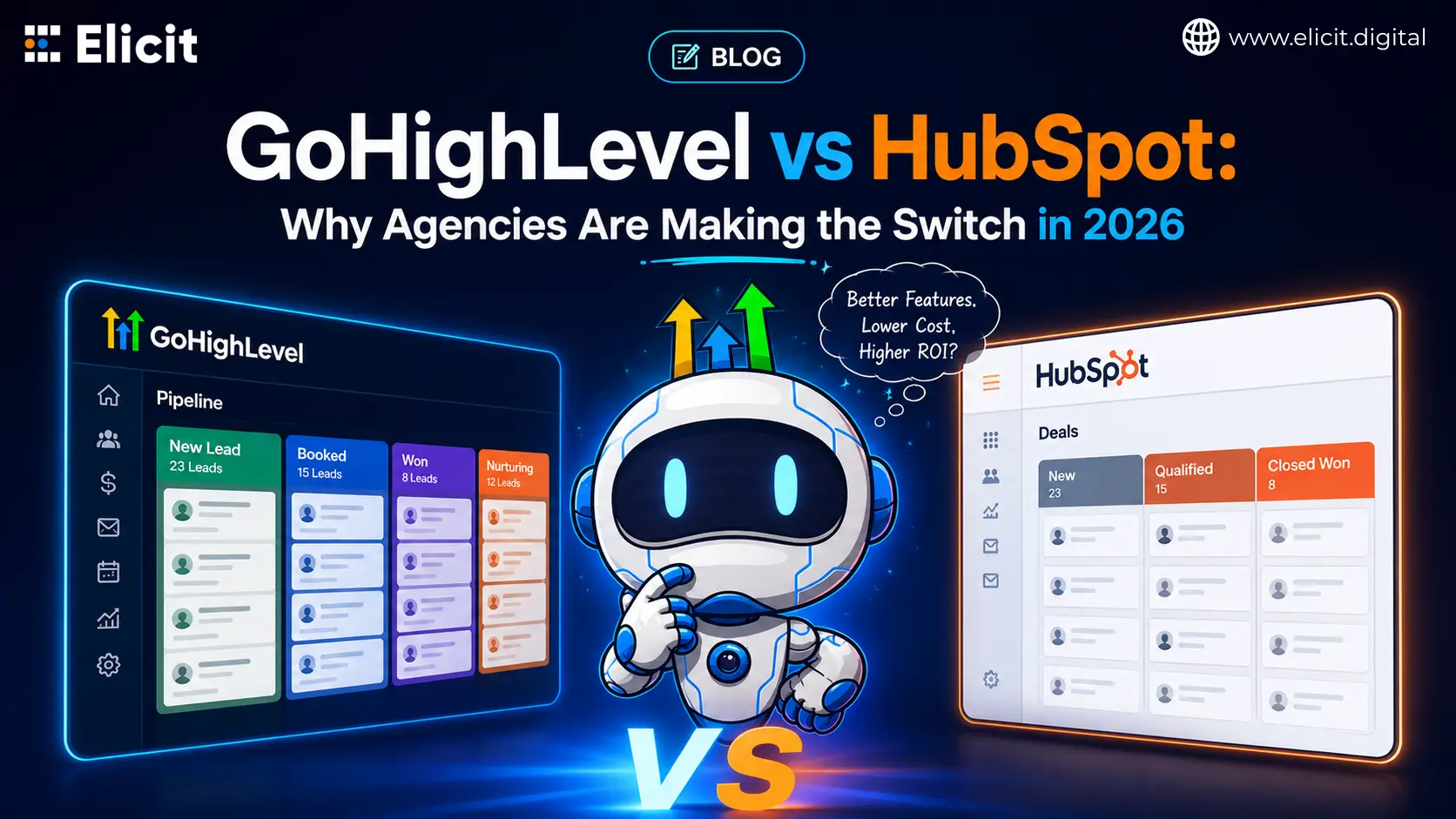
GoHighLevel vs HubSpot - Why Agencies Are Making the Switch in 2026
|
🔑 5 Key Takeaways 1. GoHighLevel and HubSpot are not actually competing for the same customer in 2026 — GHL is built for agencies managing multiple clients, HubSpot is built for in-house marketing teams. The mistake most agencies make is evaluating them as if they are interchangeable. 2. The pricing gap is larger than most comparison articles acknowledge: an agency managing 10 clients on HubSpot Professional pays $8,900+/month. The same agency on GoHighLevel Unlimited pays $297/month — a difference of over $100,000 per year. 3. GoHighLevel's 2026 AI stack — Agent Studio, Voice AI, and Conversation AI — gives agencies a genuine autonomous lead qualification and booking capability. HubSpot's Breeze AI focuses on content generation, not autonomous agents. 4. HubSpot genuinely wins on reporting depth, third-party integrations (1,500+ vs 400+), and enterprise CRM customisation. If your business is a large single brand with complex revenue attribution needs, HubSpot may still be the right choice. 5. The switch from HubSpot to GoHighLevel is not just a cost decision — it is an architectural one. GHL's sub-account model, white-label capability, and built-in SaaS reselling infrastructure are features HubSpot does not offer at any price point. |
Let's Be Honest About This Comparison
Most GoHighLevel vs HubSpot articles are written by someone who has already decided which platform to recommend and built the argument backwards from there. This one is not going to do that. Both platforms are genuinely good at what they are designed for. The problem is that a lot of agencies are using the wrong one and paying for it, sometimes literally.
Here is the honest version: gohighlevel marketing automation is built for agencies that manage multiple clients and need an all-in-one platform at a flat monthly rate. HubSpot is built for in-house marketing, sales, and service teams at mid-market to enterprise companies that want a modular CRM ecosystem they can scale into over time. Those are fundamentally different use cases and the moment you understand that distinction, the decision becomes a lot clearer.
If you run a digital agency managing 10, 20, or 50 clients, you are probably paying far more than you need to on HubSpot, and getting access to far fewer agency-specific features than GHL provides at a fraction of the cost. If you are an in-house marketing team at a scaling company that needs deep pipeline reporting and 1,500 native integrations, HubSpot is probably still the right call.
This guide gives you both sides. We are Gohighlevel Experts at Elicit Digital - so yes, we have a point of view. But we have also helped agencies make this transition and watched some stay on HubSpot for good reasons. We will tell you both.
GoHighLevel vs HubSpot: Side-by-Side Feature Comparison
Before the context and nuance, here is the straight comparison across the factors that matter most to agencies:
|
Feature / Factor |
GoHighLevel |
HubSpot |
|
Pricing |
$97 – $497/mo flat rate, unlimited contacts & users |
Free tier; Professional from $890/mo; scales to $3,600+/mo |
|
Agency Sub-Accounts |
Unlimited sub-accounts on $297/mo Unlimited plan |
No sub-account model — separate paid accounts per client |
|
White-Label |
Full white-label on $497/mo SaaS Pro plan |
No white-label — clients always see HubSpot branding |
|
Contacts / Users |
Unlimited on all plans |
Tier-based — costs scale with contact count and seat count |
|
All-In-One Coverage |
CRM, funnels, SMS, email, calendar, courses, AI agent |
Modular hubs — pay separately for each capability |
|
AI Features (2026) |
Agent Studio, Voice AI, Conversation AI booking bot |
Breeze AI — content generation, email suggestions |
|
Reporting & Analytics |
Solid for agency reporting; improving in 2026 |
Best-in-class custom reporting & revenue attribution |
|
Native Integrations |
400+ and growing; native HubSpot integration added May 2026 |
1,500+ native integrations, deep ecosystem |
|
Funnel & Page Builder |
Built-in; industry-specific templates included |
Basic — relies on third-party tools or Content Hub |
|
Reputation Management |
Built-in review automation & monitoring |
Not native — requires third-party integration |
|
SaaS Reselling |
Full SaaS Mode — resell as your own software |
HubSpot Partner Programme only; client sees HubSpot brand |
|
Best For |
Agencies, consultants, service businesses, SMBs |
Mid-market to enterprise in-house marketing & sales teams |
|
Trial Period |
30-day full-access free trial |
Free tier (limited); 14-day trial for paid features |
The Pricing Reality Nobody Puts in a Table
The headline pricing comparison — GHL at $97 to $497/month versus HubSpot's free tier — undersells how different these costs become in practice for agencies. HubSpot's free CRM is genuinely useful for a single business keeping track of contacts. The moment you start adding marketing automation, sequences, A/B testing, or multiple users on paid seats, the price moves fast.
For agencies specifically, the cost gap is severe. HighLevel's Marketing Automation platform charges $297/month for unlimited sub-accounts, unlimited contacts, unlimited users, and full workflow automation across every client account. HubSpot's Marketing Hub Professional starts at $890/month — per brand. An agency with ten clients on separate HubSpot accounts pays $8,900/month or more for the equivalent setup. That is over $100,000 per year against GHL's $3,564 per year.
|
Scenario |
GoHighLevel Cost/mo |
HubSpot Equivalent Cost/mo |
|
Single business (basic CRM) |
$97 (Starter) |
$0 (Free CRM) or $20 (Starter seat) |
|
Agency — 5 clients |
$297 (Unlimited) |
$890 x 5 = $4,450 (Pro, separate accounts) |
|
Agency — 10 clients |
$297 (Unlimited) |
$890 x 10 = $8,900/mo+ |
|
Agency — 20 clients |
$297 (Unlimited) |
$890 x 20 = $17,800/mo+ |
|
White-label reseller |
$497 (SaaS Pro) |
Not available — no GHL equivalent |
|
Enterprise single brand |
$297–$497 |
$3,600/mo (Enterprise suite) |
|
💡 There is also the usage cost layer in GHL. Pass-through costs from Twilio and Mailgun for SMS, calls, and email mean a realistic agency scenario — 50,000 emails, 5,000 SMS, 500 call minutes per month — adds roughly $80 to $120/month on top of the base plan. Even with this factored in, GHL is 10x to 30x cheaper than HubSpot for multi-client agency use. |
Where GoHighLevel Wins for Agencies
Sub-Account Architecture
This is the structural difference that matters most. GHL's Unlimited plan gives you a dedicated sub-account for every client separate contacts, pipelines, automations, reporting, and calendar booking — all manageable from a single agency dashboard. On HubSpot, managing multiple clients means either paying for a separate account per client (at $890+/month each) or cramming everyone into one account with naming conventions and folder structures holding everything together. That second option breaks down fast at scale.
White-Label and SaaS Reselling
HubSpot has no white-label capability. Clients always see HubSpot's branding. GHL's SaaS Pro plan at $497/month lets you rebrand the entire platform your domain, your logo, your pricing — and resell it as your own software product. HighLevel's Marketing Automation infrastructure becomes your product. This is a revenue model HubSpot simply cannot offer, at any price.
All-In-One Coverage at a Flat Rate
With GoHighLevel at $297/month, you get CRM, funnel builder, website builder, email and SMS marketing, calendar booking, reputation management, course hosting, community builder, and AI agent tools. HubSpot structures these as separate Hubs - Marketing Hub, Sales Hub, Service Hub, Content Hub - each priced individually. Getting the equivalent coverage in HubSpot means stacking multiple Hub subscriptions, which can reach $3,600/month at the enterprise tier.
AI Agent Capabilities in 2026
This is where the gap has opened up most significantly in 2026. GHL marketing automation now includes Agent Studio for configuring an AI Employee that handles lead qualification and appointment booking autonomously. Voice AI handles inbound and outbound calls. Conversation AI manages text-based qualification and can book appointments without any human involvement, one agency reported it capturing 79 phone numbers and booking 20% of those calls automatically. HubSpot's Breeze AI focuses on content generation and email subject line suggestions - useful productivity tools, but not autonomous agents.
30-Day Free Trial
GoHighLevel offers one of the longest free trials in the CRM space - 30 days with full platform access, no credit card required on most affiliate links. This is enough time to build a complete funnel, run a real automation sequence, and connect your calendar before paying a cent. HubSpot's free tier is a genuinely useful limited CRM, but accessing the paid automation features requires a trial or subscription.
Where HubSpot Still Wins (Be Honest)
Saying GoHighLevel is better for agencies does not mean HubSpot is worse at everything. There are areas where HubSpot genuinely leads and knowing those areas is how you make a good decision rather than just a cheap one.
Reporting and Revenue Attribution
HubSpot's custom reporting, multi-touch revenue attribution, and deal forecasting at the Professional and Enterprise tiers are best-in-class. If you are a company with a complex sales cycle, multiple deal stages, and a board that wants accurate revenue attribution across marketing channels, HubSpot's analytics are meaningfully deeper than what GHL currently provides. GHL's reporting is solid and improving in 2026, but it has not matched HubSpot at the enterprise analytics level.
Native Integrations
HubSpot has 1,500+ native integrations versus GHL's 400+. If your business runs on Salesforce, NetSuite, SAP, or a complex enterprise tech stack, HubSpot's integration depth is a significant advantage. GHL added a native HubSpot integration in May 2026 covering contact operations, and its Zapier and API capabilities cover most use cases — but if you need out-of-the-box connections to enterprise tools, HubSpot still has the broader ecosystem.
Enterprise CRM Customisation
HubSpot's enterprise tier allows deeply customised CRM objects, property groups, and complex permission structures that large organisations need. GoHighLevel is a better fit for service businesses and agencies than for companies with enterprise-grade CRM requirements across multiple business units. If you are evaluating on behalf of a 500-person sales organisation, HubSpot's CRM depth matters.
|
⚠️ The honest summary: if you are an agency managing clients, GoHighLevel wins on almost every dimension. If you are a single brand with enterprise reporting needs, complex integrations, or a very large in-house sales team, HubSpot may genuinely be the better fit. The mistake is choosing the wrong tool for the wrong reason. |
How to Switch From HubSpot to GoHighLevel Without Losing Everything
The most common reason agencies stay on HubSpot longer than they should is the migration fear. Years of contacts, pipelines, email history, and automations feel impossible to move. In practice, the switch is more manageable than it looks - especially with a specialist handling it.
1. Export your HubSpot data: Contacts, companies, deals, notes, and task history all export cleanly as CSV from HubSpot. Email templates and sequences export as HTML or text. This is your source of truth for the migration.
2. Set up GHL sub-accounts: Create a dedicated sub-account for each client in your GHL Unlimited plan. Map your HubSpot deal stages to GHL pipeline stages before importing anything — the structure needs to match first.
3. Import contacts and CRM data: GHL's CSV import handles contact, company, and custom field data. Map your HubSpot property fields to GHL custom fields during import. Standard contacts migrate cleanly; complex property structures may need light mapping work.
4. Rebuild your automation sequences: This is the step that takes the most time. GHL's workflow builder is more visual and arguably more powerful than HubSpot's Sequences, but they work differently. Rebuilding 10 to 15 sequences typically takes 8 to 16 hours for someone experienced with both platforms.
5. Configure your integrations: GHL's native HubSpot integration (added May 2026) syncs contacts bidirectionally during a parallel-run period. For other third-party tools, GHL's Zapier connection or API handles most use cases. Run both platforms in parallel for 2 to 4 weeks to catch anything the migration missed.
6. Test and go live: Test every workflow, every calendar booking, every form submission, and every automation sequence in a dummy contact before switching off HubSpot. Do not cancel HubSpot until you have run at least one complete lead cycle through GHL successfully.
|
💡 Working with GoHighLevel CRM experts for the migration typically takes the parallel-run period from 4 weeks down to 48 hours. Specialists who have migrated from HubSpot before know where the edge cases are — custom property mapping, email deliverability setup, A2P registration for SMS — and can handle them without disrupting client operations. |
AEO, GEO & AIO: How GoHighLevel Is Winning in AI Search in 2026
This section is relevant if you are an agency evaluating GHL not just as a client management tool but as a platform you want to build content authority around. In 2026, the agencies that are winning in AI search are the ones who understand what AEO, GEO, and AIO actually mean for their visibility and GoHighLevel's platform suandpports all three better than HubSpot's positioning does.
|
AEO — Answer Engine Optimisation |
GEO — Generative Engine Optimisation |
AIO — AI Inside GoHighLevel |
|
Win GHL-related queries in AI Overviews Structure your agency's GoHighLevel service pages and blog content to directly answer the questions buyers search in 2026: 'Is GoHighLevel better than HubSpot?', 'How much does GoHighLevel cost for agencies?', 'Can GoHighLevel replace HubSpot?'. Add FAQPage schema. Pages with direct-answer content are cited in Google AI Overviews at zero cost per click. |
Get cited when ChatGPT answers CRM questions When a business owner asks ChatGPT 'which CRM should I use for my marketing agency?', AI tools cite brands from structured, authoritative content. Publishing detailed, well-cited comparison guides — like this one — makes your agency the source AI refers to. GEO is how you earn discovery before a prospect ever loads Google. |
GHL's AI stack is a competitive edge GoHighLevel's Agent Studio, Voice AI, and Conversation AI let agencies deliver AI-powered services on top of the platform. Configure an AI receptionist for a dental client, a 24/7 lead qualification bot for a mortgage broker, or an autonomous follow-up agent for a fitness studio — all inside one GHL sub-account. This is a service line HubSpot cannot support at the SMB level. |
Frequently Asked Questions
Q: Is GoHighLevel better than HubSpot for agencies?
For most agencies, yes — especially those managing multiple clients on a per-seat or per-account budget. gohighlevel marketing automation runs on a flat $297/month Unlimited plan with unlimited sub-accounts, contacts, and users. An equivalent agency setup on HubSpot Professional means separate accounts at $890+/month each. For a 10-client agency, that is the difference between $297/month and $8,900/month. Beyond cost, GHL's sub-account model, white-label capability, and built-in SaaS reselling features are specifically designed for agency operations HubSpot has no equivalent.
Q: Can GoHighLevel replace HubSpot completely?
For agencies and service businesses: almost always yes. GoHighLevel covers CRM, email and SMS marketing, funnel building, calendar booking, reputation management, course hosting, and AI agent tools in one platform at a flat rate. The areas where it does not fully replace HubSpot are enterprise-level revenue attribution reporting, large-scale native integrations (HubSpot has 1,500+ vs GHL's 400+), and deep enterprise CRM customisation for complex multi-unit organisations. For most agencies, these gaps are not relevant to their actual use case.
Q: How long does it take to migrate from HubSpot to GoHighLevel?
A basic migration — contacts, pipelines, and core automations typically takes 2 to 5 business days with a specialist handling the work. A full migration including all workflow rebuilds, custom fields, email template recreation, integration reconfiguration, and a parallel testing period takes 2 to 4 weeks. Working with GoHighLevel migration experts compresses the timeline significantly and eliminates the most common errors particularly around contact mapping, custom field structure, and A2P 10DLC SMS registration for US clients.
Q: Is GoHighLevel hard to set up compared to HubSpot?
The learning curve is different, not necessarily steeper. HubSpot's onboarding is more guided for first-time CRM users it has a polished setup wizard and a large library of tutorials. GoHighLevel has more configuration options upfront (sub-accounts, white-label domains, SaaS pricing tiers) which can feel overwhelming initially. For agencies that have not used GHL before, working with gohighlevel CRM experts significantly reduces setup time from 40+ hours of self-guided setup to a production-ready configuration in 48 hours.
Q: Does GoHighLevel integrate with HubSpot?
Yes. As of May 2026, GoHighLevel has a native HubSpot integration built directly into the Workflow Builder. It includes an instant trigger when new contacts are created in HubSpot, plus actions to create and find HubSpot contacts from GHL workflows. OAuth authentication is built in no Zapier or third-party middleware needed for contact sync. The integration currently covers contact operations; deal and ticket triggers are on the 2026 roadmap. For advanced use cases beyond contacts, Zapier and direct API connections are available.
The Switch Is Not for Everyone, But for Most Agencies, It Is Overdue
GoHighLevel does not win this comparison because HubSpot is a bad product. It wins for agencies because it was built for agencies. Sub-accounts, flat pricing, white-label capability, SaaS reselling, and an AI stack built for autonomous client management none of these things exist in HubSpot because HubSpot was never designed to serve that market.
The agencies paying $8,000 to $15,000 per month in HubSpot fees while managing 10 to 20 clients are not getting 30x more value than a GHL agency. They are paying 30x more for a platform that is simply not designed for what they are trying to do with it.
If you are ready to evaluate the switch properly, not just read about it the right move is to run GoHighLevel's 30-day free trial, set up one real client workflow, and see whether the platform fits your operations before committing. And if you want the setup done right the first time, our team of gohighlevel CRM experts at Elicit Digital builds production-ready GHL setups for agencies globally, typically delivered in 48 hours.
The honest summary: if you are an agency, GHL almost certainly makes more operational and financial sense. If you are an enterprise in-house team with complex reporting and integration needs, HubSpot may still be the better fit. Work with Gohighlevel Experts who understand both platforms well enough to give you an objective recommendation for your specific situation not just a pitch.
|
Contact Us Now Considering the switch from HubSpot to GoHighLevel? Our GoHighLevel Experts handle the full migration — CRM, contacts, pipelines, and automations. Zero downtime. 📞 Phone: +91 9111555876 ✉ Email: sales@elicit.digital 🌐 Website: www.elicit.digital |
|
Ready to Make the Switch? Let's Build Your GHL Setup in 48 Hours. Elicit Digital's GoHighLevel CRM experts migrate agencies from HubSpot to GHL without losing a single contact, pipeline, or workflow and configure a production-ready GHL setup with niche snapshots, automated sequences, and AI booking bots. We've done this for agencies across India, UAE, UK, and the US. 👉 Book Your Free GoHighLevel Migration Call → elicit.digital/gohigh-level |