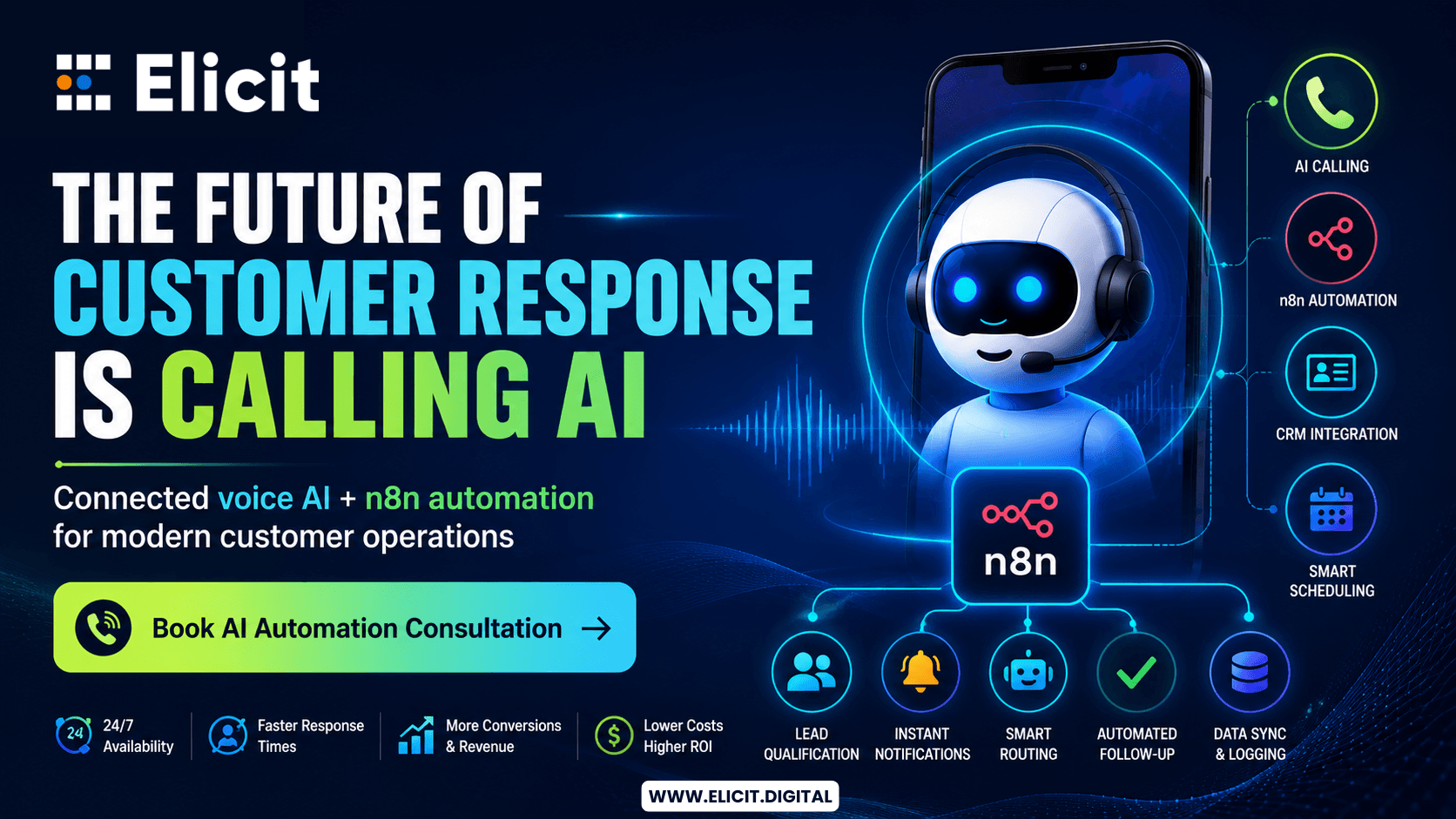
Calling AI Agent + n8n Automation: The New Customer Response Infrastructure for Modern Brands
Key Takeaways
- Modern businesses are shifting from manual phone handling to AI-powered customer response infrastructure.
- A properly deployed Calling AI Agent can automatically answer, qualify, route, and escalate customer conversations.
- n8n automation enables voice AI systems to connect with CRM workflows, APIs, calendars, and business operations.
- Customer communication automation is becoming an operational advantage, not just a support experiment.
- Businesses adopting intelligent Customer Automation early are creating faster response systems and stronger service consistency.
Customer expectations changed faster than most business communication systems.
People expect immediate responses.
No callbacks tomorrow.
Not voicemail loops.
Not missed opportunities because nobody answered the phone.
That is why businesses are beginning to rethink customer communication infrastructure entirely.
Businesses exploring AI-driven operations often begin with advanced n8n automation architecture before deploying customer-facing AI workflows.
The conversation is no longer:
“Should we automate support?”
The new question is:
“Can AI handle customer conversations operationally?”
This is where the rise of the Calling AI Agent becomes commercially important.
When properly connected with n8n automation, AI can answer inbound calls, qualify leads, route calls based on intent, trigger CRM actions, book appointments, escalate to human teams, log conversations automatically, and activate downstream workflows.
Customer communication is rapidly becoming infrastructure, not just a staffing function.
Customer Communication Is Becoming Infrastructure
Most businesses still treat phone communication as a staffing function.
Someone answers. Someone routes. Someone takes notes. Someone follows up.
That model creates bottlenecks because human availability does not scale predictably.
Missed calls create lost opportunities. Response consistency varies. After-hours inquiries disappear. Operational dependency increases.
Modern brands are redesigning customer communication as infrastructure, not staffing dependency.

What a Calling AI Agent Actually Does
A lot of businesses misunderstand voice AI.
They imagine IVR menus or robotic call trees.
Modern voice AI automation is moving far beyond scripted systems into operational customer workflows.
A real Calling AI Agent can:
- understand conversational intent
- ask qualification questions
- route by business logic
- interact with APIs
- confirm appointments
- update records
- notify teams
- escalate when necessary
The AI becomes operational, not informational.
That shift is similar to how businesses are now adopting custom AI agent deployment frameworks for broader operational automation.
Why n8n Changes the Entire AI Calling Conversation
Voice AI alone is useful.
Disconnected voice AI is limited.
The real power emerges when AI calling connects to business workflows.
This is where n8n automation becomes strategically valuable.
Because n8n allows voice interactions to trigger:
- CRM updates
- appointment scheduling
- Slack alerts
- webhook actions
- API lookups
- lead routing
- support escalation
- post-call automations
This is where connected CRM workflow automation creates real operational value.
The business gains AI-driven operational workflows.
This is the same infrastructure strategy we explored in our earlier breakdown of advanced AI workflow systems built with n8n.
Real Example: AI Front Desk for Appointment Businesses
Imagine a clinic.
A customer calls after hours.
Traditional result: voicemail. Delayed follow-up. Lost intent.
AI-driven result:
The Calling AI Agent answers instantly.
It identifies inquiry type, checks appointment availability, confirms customer details, books or escalates, triggers CRM updates, and notifies internal teams.
The customer gets immediate service.
The business protects opportunity value.
That is not theoretical anymore. That is modern Customer Automation.
Still Missing Calls That Could Become Revenue?
Modern customers expect immediate answers.
If your business still depends entirely on human availability for every customer call, opportunity leakage is inevitable.
AI calling infrastructure can help automate:
- Inbound call handling
- Qualification workflows
- appointment booking
- CRM actions
- Escalation routing
- After-hours customer response
Book AI Calling Strategy Consultation
Request n8n Automation Demo
Why AI Calling Matters Beyond Support
Most businesses initially view AI calling as support automation.
That is too narrow.
Voice AI can improve lead qualification, sales routing, booking recovery, callback automation, after-hours engagement, and customer onboarding.
This becomes a revenue conversation, not only a support conversation.
The Biggest Mistake Businesses Make
The most common mistake?
Deploying voice AI without workflow orchestration.
That creates disconnected conversations.
The AI talks, but does not act.
Businesses exploring AI customer response systems often underestimate the importance of backend workflow orchestration.
We covered a similar architecture challenge in our earlier breakdown of AI systems that automate real business operations.
Without backend automation:
- No CRM updates
- No follow-up triggers
- No appointment logic
- No routing intelligence
- No escalation systems
AI conversation alone is not enough.
Operational execution is the real differentiator.
Why Early Adopters Will Build Stronger Customer Experience Systems
Customer expectations are moving faster than many businesses realize.
Businesses relying entirely on manual response infrastructure will struggle to match speed expectations.
That creates conversion loss, inconsistent service, operational strain, and higher staffing dependency.
Meanwhile, automation-first businesses create always-on responsiveness.
Where Elicit Digital Helps
At Elicit Digital, we help businesses architect modern AI-powered customer response systems.
Businesses planning deployment often begin with an AI automation infrastructure consultation before choosing implementation architecture.
That includes:
- Calling AI Agent deployment
- advanced n8n automation
- CRM integrations
- API workflow orchestration
- booking automation
- escalation logic
- operational AI infrastructure
The goal is not simply AI conversation.
It is AI execution.
Final Thought
Customer response infrastructure is changing.
Businesses that adapt early will create faster responses, stronger customer experiences, lower dependency on manual bottlenecks, and better conversion protection.
The question is no longer whether AI can answer calls.
The real question is:
Can your customer communication system execute operationally?
Ready to Build AI-Powered Customer Response Infrastructure?
If your business wants to automate inbound calls, customer qualification, CRM actions, and connected workflows, we can help.
We help businesses deploy Calling AI Agent infrastructure, advanced n8n automation, and scalable Customer Automation workflows.
Book AI Automation Consultation
Talk to an n8n Automation Expert
FAQs
What is a Calling AI Agent?
An AI-powered voice system that answers calls, understands intent, routes conversations, and triggers operational workflows.
Why connect voice AI with n8n?
Because n8n allows voice interactions to trigger CRM actions, scheduling, alerts, and backend workflow automation.
Is this useful for local businesses?
Yes, especially appointment-driven, service-based healthcare, and sales-heavy businesses.
Can AI book appointments automatically?
Yes, when integrated with scheduling systems and workflow automation logic.