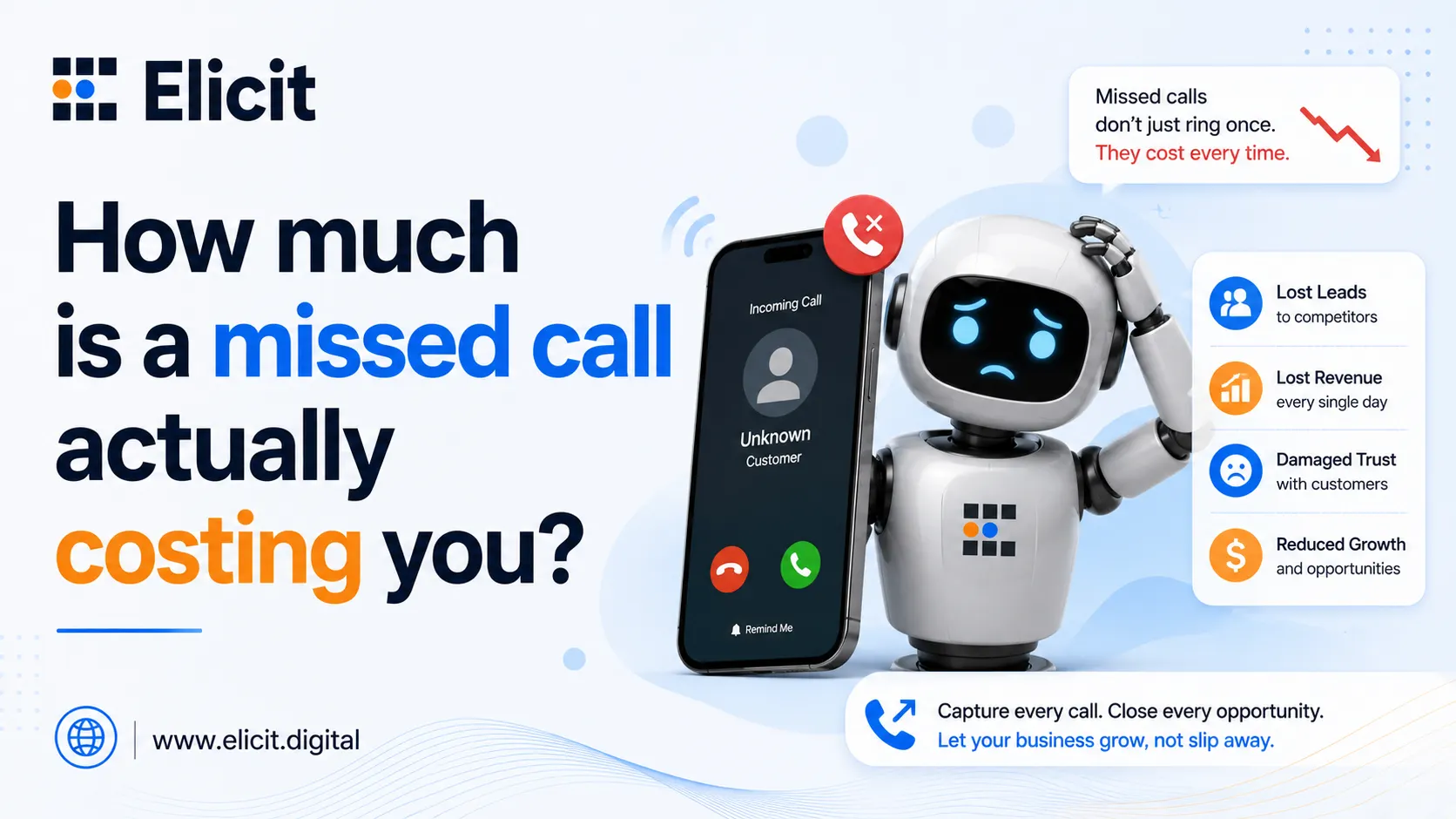
GHL Missed Call Text Back - The $10K Feature
Missed Call Text Back is a native GoHighLevel workflow that automatically sends a text message to anyone whose call goes unanswered — turning a lost inbound call into a booked appointment, a warm lead, or at minimum a conversation that didn't just die on a voicemail nobody checks. It costs nothing beyond your existing GHL subscription, takes about ten minutes to set up, and most businesses running GHL still don't have it switched on. That gap is the $10K.
Below is the actual math behind that number, exactly how the feature works, the setup steps, and why this is the single highest-ROI workflow sitting unused in most GHL accounts today.
|
Key Takeaways 1. Missed calls are not neutral — they're lost revenue. Industry data puts missed-call abandonment at 20-35% for small businesses, and most of those callers don't call back. 2. Missed Call Text Back recovers 15-25% of missed calls into a booking or a warm reschedule, based on real client accounts we've measured. 3. The $10K figure isn't marketing hype — it's simple math. A business missing 15 calls a month, converting even a third of those to a $150 average job, is leaving over $9,000 a year on the table. 4. It's free to build and takes about 10 minutes. No app purchase, no third-party tool — it's a native ghl workflow automation sitting in every account already. 5. The businesses that need this most rarely have anyone answering every call. Trades, clinics, salons, and local services are exactly the accounts where this feature goes unused and matters most. |
Why Missed Calls Quietly Cost More Than People Think
Every missed call is a moment where someone wanted to give a business money and the business wasn't there to take it. That's the whole problem, stated plainly.
The data on this is consistent across industries. Forrester and multiple call-tracking platforms have published figures putting small business missed-call rates between 20% and 35% of total inbound volume — meaning for every 100 calls a local business receives, 20 to 35 never get answered. Of those missed callers, most studies find fewer than 20% call back a second time. They call the next business on the list instead.
For a dental practice, salon, HVAC company, or law firm running any kind of GHL marketing automation to drive inbound calls, this means a real share of the leads that ad spend paid for are being thrown away at the exact moment they were most interested — the moment they picked up the phone.
The Actual $10K Math
Nobody should trust a headline number without seeing the arithmetic, so here it is plainly.
Take a modest local service business: 500 inbound calls a month, a 25% missed-call rate (in the middle of the documented range), and an average job value of $150.
|
500 calls × 25% missed = 125 missed calls per month Missed Call Text Back recovers ~20% of those (conservative) = 25 recovered calls per month 25 recovered calls × $150 average job = $3,750 per month Annualized: $45,000 per year |
Even accounting for lower call volume, a lower average job value, or a more conservative recovery rate, the number rarely drops below five figures annually for a business doing meaningful call volume. "$10K" is the honest floor, not the ceiling — for a lot of businesses, this workflow is worth considerably more than that once you run their actual numbers.
What Missed Call Text Back Actually Does
The mechanics are simple by design. When an inbound call to a GHL-connected number goes unanswered — no pickup within the configured ring time — the platform automatically fires an SMS to the caller within seconds. The message usually looks something like:
"Hey, sorry we missed you! Grab a time that works here: [booking link] or reply and we'll call you back shortly."
That single text does three things at once: it acknowledges the caller so they don't feel ignored, it gives them an immediate self-serve path to book without waiting on a callback, and it opens a two-way SMS conversation for anyone who'd rather just reply than click a link. All of this happens without a human touching it — the same hands-off principle that makes HighLevel's Marketing Automation worth building out beyond just this one workflow.
This is the highest-leverage entry point into a broader gohighlevel marketing automation stack, because it captures a lead at the single moment of highest intent — right when they called — rather than hoping they remember to try again later.
Setting It Up (10 Minutes, Start to Finish)
Where: Sub-account → Automation → Workflows → + New Workflow
Step 1 — Trigger. Select Call Status → Missed. This fires the moment a call isn't answered within the ring window configured on that number.
Step 2 — Add a short delay. Thirty seconds is typical — long enough to avoid overlapping with an actual callback, short enough that the text still feels immediate.
Step 3 — Send the SMS. Keep it short, personal-sounding, and include a booking link:
|
Hey {{contact.first_name}}, sorry we missed your call! Grab a time here: {{calendar.link}} Or just reply and we'll call you back shortly. |
Step 4 — Add a tag. Tag the contact missed-call-recovered so you can track this specific pipeline segment separately from other lead sources. This is the small detail that lets you actually measure the ROI instead of guessing at it later.
Step 5 — Optional: notify staff. A parallel Slack or internal notification lets a team member follow up personally on any missed call that doesn't book within an hour, catching the leads the automated text alone doesn't convert.
That's the entire build. Every serious gohighlevel tools setup includes this as one of the first three workflows configured on a new account, because the time-to-value is close to instant.
Why So Many Businesses Still Don't Have This On
Three reasons come up constantly when we audit accounts that don't have it running:
They set up GHL for one thing and never came back. A huge share of GHL accounts get configured for a single campaign — a funnel, an email sequence — and nobody ever tours the rest of what the platform includes. Missed Call Text Back sits unused simply because nobody knew it existed.
They assume their team answers every call. Almost no business actually does, especially outside business hours, during lunch, or when a single receptionist is juggling three lines. The gap is usually bigger than owners estimate until they pull the actual call log.
Nobody owns ongoing optimization. A workflow built once during onboarding and never revisited is common. This is exactly the kind of gap that gohighlevel CRM experts catch during an account audit — the workflow existed in theory, the messaging was outdated, the calendar link was broken, or it was never turned on in the first place.
Getting More Out of It Once It's Running
A/B test the message. A slightly more casual tone ("Hey, sorry we missed you!") often outperforms a formal one ("Thank you for calling, please schedule below") in reply and booking rates. Test both against your actual audience rather than assuming.
Route by time of day. After-hours misses can get a different message than during-business-hours misses, since the urgency and expected response time differ.
Layer in a second follow-up. If the missed-call text doesn't convert within an hour, a second, different message ("Still looking to book? Here's that link again") often catches a portion of the remainder.
Connect it to your broader pipeline. A proper ghl crm integration means the recovered lead doesn't sit in isolation — it flows into the same nurture sequences, reporting, and staff notifications as every other lead source, so nothing falls through a second time.
When to Bring In Help
If you're comfortable inside GHL's workflow builder, this is genuinely a DIY-friendly feature — ten minutes, no code, no complexity. Most businesses can build this themselves in the time it took to read this article.
Where it's worth hiring go high level experts is when you're managing multiple sub-accounts, need this deployed consistently across a franchise or multi-location business, or want the surrounding pipeline — tagging, reporting, staff alerts, integration with existing CRM data — built properly rather than bolted on. That's the difference between a workflow that exists and a workflow that's actually optimized.
FAQ
Does Missed Call Text Back cost extra in GoHighLevel?
No. It's a native workflow available on every standard GHL plan — no add-on purchase required. SMS sending costs apply per message at your account's standard rate, same as any other text workflow.
Will this work for calls forwarded from another number?
Yes, as long as the call is routed through a GHL-connected number and the missed-call status is logged by the platform. Forwarded calls that bypass GHL's phone system won't trigger the workflow.
How fast does the text actually send?
Typically within seconds of the call being marked missed, plus whatever delay you configure (commonly 15-60 seconds). Speed matters — the faster the response, the higher the reply rate.
Can I customize the message per location or campaign?
Yes. Multi-location businesses commonly build separate versions of this workflow per sub-account or per phone number so the message and booking link match the specific location the caller reached.
What's a realistic recovery rate to expect?
15-25% of missed calls converting to a booking or a genuine warm reply is a realistic range based on real client accounts. Results vary by industry, response speed, and message quality — see the Ghl Pricing & Automation breakdown for how this fits into overall account economics.
|
Ready to Stop Losing Calls You Already Paid For? Every missed call that goes unanswered and unattended is a lead your ad spend already earned, quietly walking to a competitor. This is the fastest fix in the entire GHL platform, and it's sitting unused in more accounts than you'd expect. Our team of Gohighlevel Experts audits accounts for exactly this kind of gap — workflows that exist on paper but aren't actually capturing revenue — and builds the ones that are missing entirely. 👉 Grab a free go high level demo — 30-minute walkthrough of Missed Call Text Back and the rest of the stack we deploy for agencies. |