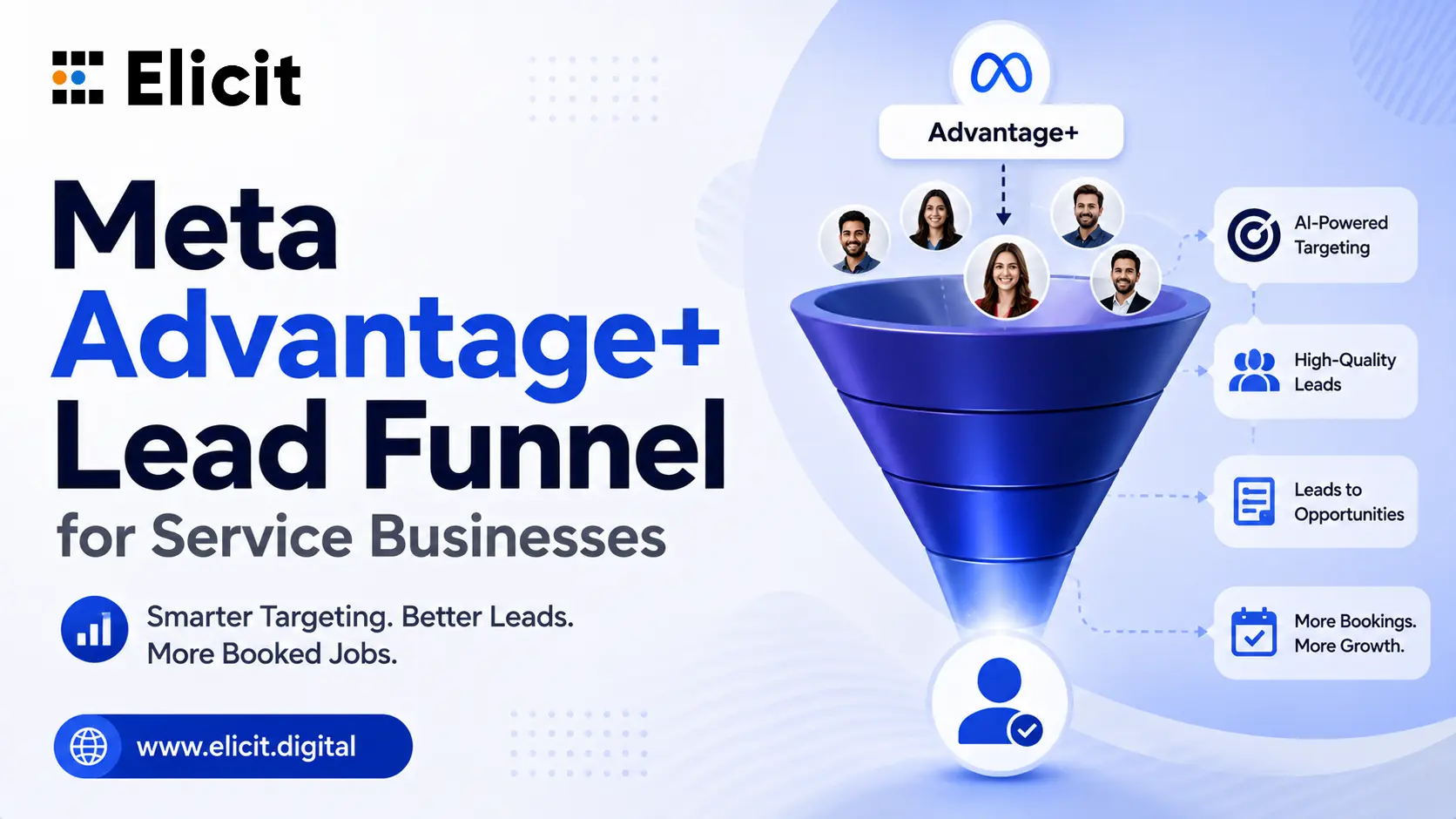
Meta Ads - What Changed for Service Businesses
Run a Meta Ads account for a service business the way you did two years ago, and you're no longer just competing against other advertisers. You're competing against an algorithm that quietly stopped listening to half your settings. Advantage+ moved from an optional toggle to the default setup screen. Manual interest targeting still technically exists, but Meta treats it as a loose suggestion the system is free to override. And the change that matters most for service businesses specifically: lead generation campaigns now run through the same automated engine that e-commerce sales campaigns have used for years.
That shift is either the best thing to happen to your cost per lead or the reason your account suddenly looks unfamiliar depending on setup. Here's what actually changed and the adjustments a lead generation agency or an in-house marketer running Meta for a service business needs to make now.
|
Key Takeaways 1. Advantage+ is the default now, not a toggle. Fighting an automated setup with manual overrides usually just fights the algorithm's confidence in itself. 2. Lead generation shares its automation engine with e-commerce sales campaigns. A real advantage, but only once weekly lead volume clears Meta's threshold. 3. Creative volume and specificity now shape ad delivery. Meta's retrieval system weighs how many distinct creative variations you're running, not just who you told it to target. 4. Attribution reporting split in two, not campaign performance. A tighter click-through definition can make a stable campaign look worse than it is. 5. Ad-side automation is wasted without lead-side automation. Meta can hand you a qualified lead in seconds. What happens in the next five minutes decides whether that speed turns into revenue. |
Why Service Businesses Feel This Shift Differently
Ecommerce brands adjusted to Advantage+ years ago because their objective was simple: feed the algorithm enough purchase events and let it optimize toward more purchases. Service businesses consultants, clinics, agencies, and home service providers never had that luxury. A phone call or a form fill is a softer signal than a completed sale, and there are far fewer of them each week.
That gap used to mean a more manually controlled version of Meta Ads: narrower audiences, longer test windows, and heavier re-targeting of people who'd already shown interest. This year's changes remove most of that manual layer. Meta now applies the same predictive budget and audience logic to a lead form that it applies to a checkout page, which means a service business either feeds the system enough qualifying actions to make that logic useful or watches an algorithm built for high-volume e-commerce data make decisions on a trickle of leads it barely understands.
What Actually Changed
Five changes matter more than the rest for a service business account.
1. Advantage+ is the default, not the option. Open Ads Manager today, and the setup flow pushes you toward Advantage+ before showing a manual alternative. Manual setup still exists, but it's no longer the default view, and the platform now discourages heavy manual restrictions on budget and placement.
2. Lead generation shares the automation engine with sales campaigns. This is the structural change that matters most. Lead forms used to be a lighter weight, less optimized objective; now the same predictive delivery system ecommerce brands have used since 2023 applies to lead campaigns too, lowering cost per qualified lead once the account clears Meta's weekly conversion threshold.
3. Creative volume and specificity now shape who sees your ad. Meta's ad retrieval system now factors in how much distinct creative you're running, not just who you targeted. A service business running two static images and one testimonial video is competing on creative thinness against accounts running a dozen variants weekly.
4. Attribution reporting split into two columns. Click-through now counts only genuine link clicks; other interactions (comments, saves, and general engagement) are moved into a separate engage-through metric. A campaign that looks worse month over month may just be reporting the same performance differently.
5. Optimization still rewards volume you may not have. Standard delivery thresholds sit near fifty qualifying events a week for some campaign types. A local business generating ten or fifteen leads weekly gives the algorithm too little to learn from a real constraint, not a settings problem.
How to Adapt Without Blowing Up What Already Works
Start with creative volume before touching targeting. Because delivery now folds in creative signals, the fastest lever a service business can pull is more creative variety, not tighter audiences. Meta's Creative Studio is one of the more useful AI tools for business owners without a production budget: it generates image and text variants from a handful of source assets a shot of your storefront, a client testimonial, or a before and after usually enough for a local account.
Aggregate your conversion events instead of spreading them thin. If weekly lead count sits below the optimization threshold, consolidate several service-specific campaigns into fewer campaigns sharing one lead event more events flowing into fewer campaigns reach a usable sample size faster than the same volume split six ways.
Fix the landing page, not just the ad. Because the job of filtering high-intent traffic has shifted away from manual audience picks and toward what happens after the click, a slow landing page or a ten-field form now costs more than it used to. Pair stronger creative with basic conversion rate optimization services on the page itself faster load time, one clear call-to-action, and a shorter form.
Read attribution month over month, not campaign by campaign. Given the click-through and engage through split, compare blended cost per lead across a full month rather than reacting to a single week's numbers.
Closing the Loop: Why Ad Automation Needs Lead Automation to Match It
Meta routing lead campaigns through the same engine as sales campaigns cuts the time between an ad click and a form submission to seconds. That speed is wasted if the lead sits in a generic inbox for six hours before anyone calls. Closing that gap is exactly what an advanced n8n workflow is built for: a form submission triggers CRM enrollment immediately, a scoring step flags who's worth an urgent call, and a Calling AI Agent can dial a qualified lead back within a couple of minutes instead of whenever someone checks the queue.
The same automation layer that captures a Meta lead can run Customer Automation once that lead becomes a client reminder sequences, review requests, renewal nudges without anyone manually copying data between platforms. Whether an in-house developer or an ai automation agency wires it, the mechanism is the same: connecting Meta's ad account to a Custom AI Agent and a CRM through n8n automation turns each campaign dollar into a documented conversation, not one more unread notification.
Businesses already running paid lead gen without a proper CRM pipeline are best positioned to benefit from n8n workflow automation the ad spend is already flowing; the missing piece is what happens the moment a lead lands.
Common Mistakes Costing Service Businesses Ad Spend Right Now
1. Fighting Advantage+ with manual overrides. Layering narrow interest restrictions on an automated campaign type starves the algorithm of flexibility, which shows up as a higher cost per lead than an unrestricted setup would produce.
2. Judging a campaign by click-through rate alone. With link clicks counted more strictly, click-through rate can drop for reporting reasons alone. Judge performance on cost per qualified lead and booking rate instead of a metric whose definition just moved.
3. Running one static creative set for months. Andromeda punishes creative fatigue faster than the old system did. A business that hasn't refreshed its ad images or video in a quarter is competing against accounts refreshing weekly.
4. Treating the Meta lead as the finish line. The ad's job ends at the form submission. What happens in the next five minutes a call, a text, a calendar link decides whether it becomes revenue, and most service businesses still leave that step to whoever checks the inbox next.
When to Bring In an Expert
Running Advantage+ well enough to generate a steady flow of qualified leads is something an in-house marketer or generalist agency can manage within a few months. Any performance marketing agency running Meta at scale for service clients is already rebuilding playbooks around these five shifts. The harder part is the handoff: turning ad platform speed into sales team speed without dropping leads in the gap.
That handoff is where hiring an n8n expert earns its fee multi-source lead intake (Meta, your website, referral forms) feeding one scoring system, different follow-up rules per source, and a Custom AI Agent trained on your specific offer instead of a generic script. Get n8n Expert Service if your Meta lead volume has outgrown what a spreadsheet and a shared inbox can handle; it starts with a straightforward audit of where leads currently get stuck between form submission and first contact.
If Meta is only one channel in a broader growth plan, a full stack digital marketing agency in India that also owns your SEO, GEO, and paid social keeps your funnel consistent instead of stitched together across vendors.
FAQ
Does Advantage+ work for service businesses that don't sell a physical product?
Yes. Since Meta merged lead generation into its automated sales engine, Advantage+ applies audience and creative learning to lead forms and messaging, not only checkout events. Most service accounts need roughly fifteen to twenty five qualifying actions a week before it has enough data to learn from.
Why did cost-per-lead reporting get harder to read this year?
Meta tightened click-through attribution to count only genuine link clicks, moving other interactions into a separate engage through metric. Compare blended cost per lead month over month instead of one week or one column the reporting split alone can make a stable campaign look like it changed.
Do I need a large creative library to compete under the new delivery system?
You need more creative variety than before, not a bigger production budget. Meta's built-in AI tools can generate image and text variants from a handful of source assets usually enough for a local service business's account size.
What's the fastest way to know if my Meta-to-lead-response gap is costing me business?
Get n8n Expert Service a free audit that traces your last twenty Meta leads from ad click to first contact and shows exactly where the delay sits.
|
Ready to Turn Meta Leads Into Booked Calls, Not Just Form Submissions? Meta's automation now moves at machine speed on the ad side. If your lead follow-up still runs on manual data entry and a shared inbox, your fastest ever lead gen setup is bottlenecked by its slowest step. We build the n8n automation layer that closes that gap. CRM sync, lead scoring, and calling agent follow-up are wired directly to your Meta lead forms. Talk to our n8n expert service, a free 30-minute audit of your current Meta-to-CRM flow, no pitch attached. |