Why E-commerce Brands Need Full-Stack Digital Marketing Services in 2026 for SEO, AI Search, Content Marketing and Performance Growth
Key Takeaways
- E-commerce growth in 2026 depends on visibility across Google, AI search, ads, and social commerce, not one channel alone.
- Affordable local SEO services and AI SEO services are now critical even for product-led online brands.
- Performance marketing agency support works best when connected with SEO, GEO targeting, and CRO funnels.
- Content marketing remains the long-term trust engine that improves both organic rankings and AI discoverability.
- Real client case studies prove that integrated digital marketing services create measurable and scalable revenue growth.
The e-commerce industry has changed dramatically over the last few years. Selling products online is no longer just about having a functional website, uploading products, and running a few ad campaigns. That old model is fading fast. In 2026, the online marketplace is more crowded than ever, customer attention is fragmented across multiple platforms, and search behavior itself is evolving through AI-generated recommendations, conversational buying assistance, and intent-driven discovery. Customers no longer follow a straight path from search to purchase. They discover products on Google, compare options through AI search tools, validate trust on Instagram or YouTube, return through remarketing ads, and often make the final decision only after consuming educational or review-based content.
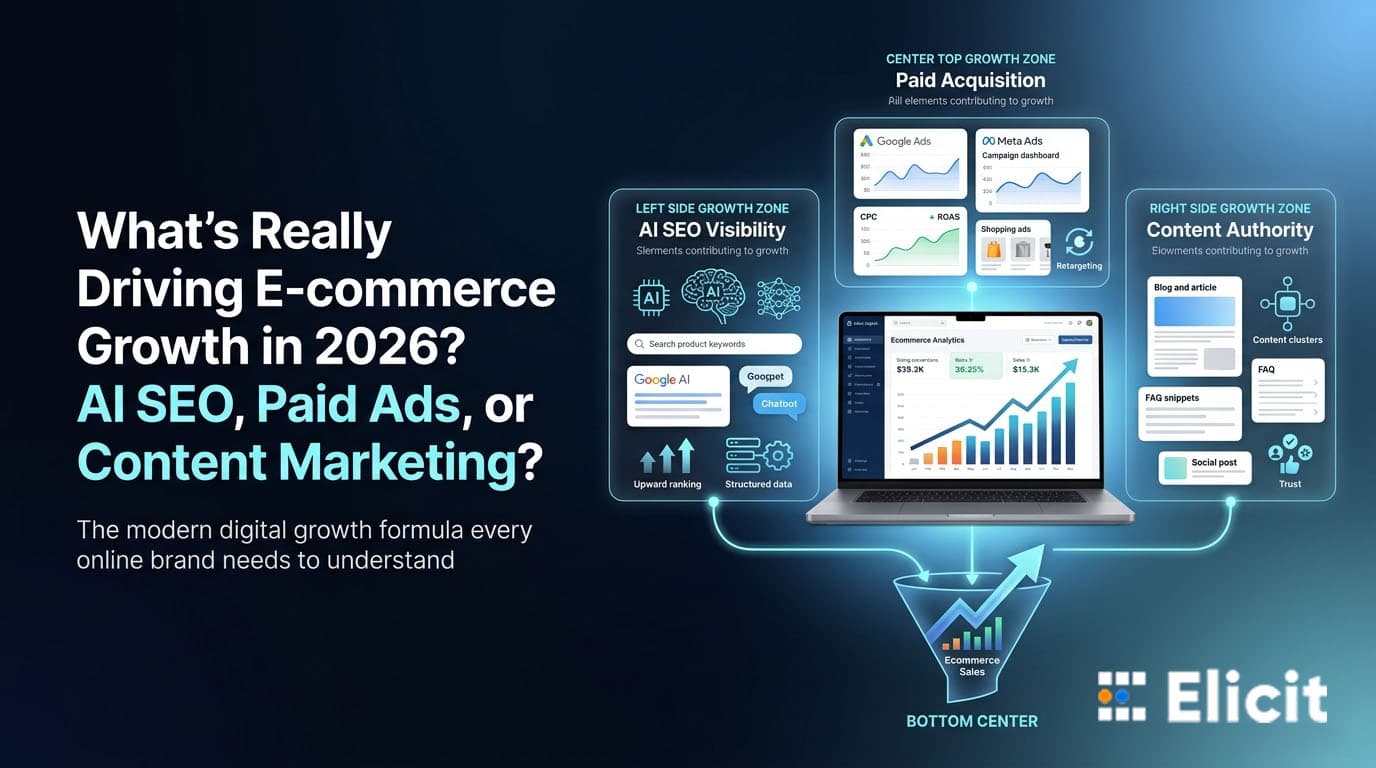
This changing buyer behavior has created one clear reality for online brands: fragmented marketing is no longer enough. An e-commerce business cannot rely only on SEO, only on paid advertising, or only on social media engagement and expect long-term sustainable growth. What brands now need is a connected growth engine, and that comes through full-stack Digital Marketing Services that align search visibility, AI discoverability, content authority, paid acquisition, and conversion optimization under one strategic system.
Brands that want sustainable online growth today are increasingly moving toward an integrated digital marketing strategy with SEO and automation, where every channel contributes to long-term visibility and conversion rather than operating in isolation.
Why Fragmented Marketing No Longer Works for E-commerce Brands
Many e-commerce businesses still operate with disconnected marketing vendors. One person handles Google Ads, another manages Meta campaigns, a freelancer works on SEO, and social media is assigned to a separate content team. On paper, this may look like a complete marketing setup, but in reality, these channels rarely communicate with each other. The customer journey, however, is fully connected. A buyer might first find a product through organic search, then see a retargeting ad, then search for reviews, and finally return after reading educational content. If the brand’s messaging, visibility, and trust signals are inconsistent across these touchpoints, conversions suffer.
This is exactly why more brands are now investing in a specialized digital marketing agency or experienced digital marketing company that can build an integrated omnichannel system instead of isolated campaign management.
How AI SEO Services Are Changing Traditional Search Visibility
One of the biggest misconceptions in e-commerce is that SEO alone will continue to drive online growth. Traditional SEO is still important, but the meaning of SEO has expanded significantly. In fact, modern SEO services are evolving beyond rankings and now include entity optimization, AI answer visibility, structured content engineering, and semantic authority development that help brands stay discoverable across changing search ecosystems. Search engines are no longer simply matching pages to keywords. They are interpreting topical authority, structured information, semantic trust, and user intent. At the same time, AI answer engines like ChatGPT, Gemini, and Perplexity are influencing how consumers gather information before making purchase decisions.
This has given rise to the demand for AI SEO services and advanced AI SEO agency support, where optimization is not limited to rankings but extends into machine-readable authority, conversational answer visibility, FAQ extraction, entity relevance, and semantic content depth.
Why SEO AEO GEO Has Become Essential for Modern Digital Marketing Services
This is where the framework of SEO AEO GEO becomes essential for modern e-commerce growth. SEO builds the traditional search foundation, AEO or Answer Engine Optimization helps a brand appear in AI-generated direct answers, and GEO or Generative Engine Optimization improves discoverability across conversational AI systems that are increasingly shaping online recommendations. In simple terms, your website no longer needs to just rank — it needs to be understood, trusted, and surfaced by both search engines and intelligent answer engines.
For product-led businesses, this shift is becoming one of the most important visibility opportunities of the decade.
Why Affordable Local SEO Services Matter Even for Online E-commerce Businesses
Another overlooked growth layer for e-commerce businesses is regional search intent. Many online brands assume that affordable local SEO services or local SEO services for small businesses only apply to physical stores, but this is no longer true. Regional buying queries are increasing because users search with localized trust signals, delivery expectations, and geographic product preferences. Searches such as imported skincare in Dubai, premium cosmetics in India, or Italian grocery products in the UAE carry much stronger purchase intent than broad national terms.
Through city-based landing pages, geo-targeted schema, localized content clusters, and regional keyword mapping, online brands can capture this demand and improve conversion rates significantly. A strong digital marketing company understands that local relevance and national e-commerce scale are no longer separate strategies.
Why a Performance Marketing Agency Alone Cannot Build Sustainable Growth
Paid acquisition is another area where many brands make expensive mistakes. Hiring a performance marketing agency can certainly generate traffic through Google Shopping, Search Ads, Meta Ads, retargeting funnels, and abandoned cart campaigns. However, performance marketing agency systems now require analytics and automation to properly track buyer behavior, optimize retargeting sequences, and reduce customer acquisition waste across multiple paid channels. But performance ads alone do not solve weak organic trust, poor landing page authority, or thin website content. Without a strong SEO and CRO foundation, paid traffic becomes increasingly expensive and customer acquisition cost continues rising.
This is why the highest-performing e-commerce brands no longer treat paid ads as a standalone growth lever. Instead, they combine paid campaigns with technical SEO, content authority, remarketing automation, and conversion funnel optimization so that every visitor enters a stronger trust environment before purchasing.
How Content Marketing Builds Long-Term Authority for E-commerce SEO
Equally important is Content marketing, which remains one of the most undervalued long-term assets in e-commerce growth. Paid ads deliver temporary bursts of traffic, but content builds compounding authority over time. That is exactly why content marketing remains the long-term authority engine for search growth, helping e-commerce brands rank for informational, transactional, and AI-driven intent queries that continue generating trust month after month. Educational blogs, buying guides, ingredient explainers, product comparisons, FAQ content, and informational category pages help brands rank for hundreds of intent-based searches beyond direct product terms.
More importantly, this content becomes a source of trust for both users and AI search systems. Search engines increasingly reward brands that demonstrate topical expertise rather than simply listing products. This means content marketing is no longer just a branding activity — it is a discoverability asset, a ranking engine, and a conversion nurturer all at once.
Real E-commerce Case Studies Showing the Impact of Full-Stack Digital Marketing Services
The effectiveness of this full-stack model is best understood through real execution.
Italfood — Building Organic Search Visibility from Zero
When Italfood approached us, the brand had almost no organic visibility despite operating in a premium niche Italian food market. There was no structured SEO architecture, no authority content, and no regional keyword targeting. We built a complete technical SEO foundation, developed AEO-focused informational food content, introduced GEO targeting for relevant international regions, and aligned social media content with product search demand. Within one year, the brand grew from zero to 606 organic traffic, ranked for more than 94 keywords, established 4.6K backlinks, and increased traffic share to 43 percent.
DailyForever52 — Combining AI SEO Services with Paid Performance Funnels
A similar integrated approach was implemented for DailyForever52, a highly competitive beauty and cosmetics brand looking to scale globally. Instead of relying only on marketplace dependence and ads, we executed full-stack SEO, AI-answer optimized content, GEO targeting across India, UAE, and international markets, Google Search and Shopping Ads, Meta retargeting funnels, and continuous CRO improvements. The result was more than 1.5K organic traffic, 184 ranking keywords, high-intent paid traffic growth, 14.6K backlinks, and 80 percent of traffic contribution coming from search-led channels.
Characters Cosmetics — Building Website and App Authority Together
For Characters Cosmetics, the challenge was broader because both the website and app ecosystem had visibility issues. We focused on technical SEO fixes, speed optimization, structured content marketing, AEO implementation, GEO-based international targeting, and ongoing maintenance across the digital ecosystem. The brand’s authority score improved to 29, keyword visibility started stabilizing across India, US, and UAE markets, and more than 8K backlinks were established to strengthen long-term search authority.
The common lesson across all three projects was simple: growth happened not because of one channel, but because SEO, AI visibility, paid media, and content marketing were built as one unified framework.
What the Best Digital Marketing Company Strategy Looks Like in 2026
This is exactly what modern e-commerce brands must understand. The winning formula in 2026 is not random outsourcing or channel-by-channel experimentation. It is investing in a connected growth model that includes Digital Marketing Services, AI SEO services, SEO AEO GEO, Content marketing, strategic local demand capture, and performance marketing execution supported by analytics and CRO. Customers now buy through an algorithm-driven, trust-sensitive, and omnichannel journey. Brands that show up consistently at every stage of that journey will dominate.
Conclusion: Digital Marketing Is Now the Revenue Infrastructure of E-commerce
In the end, digital marketing is no longer just promotion. For e-commerce businesses, it has become the infrastructure behind sustainable visibility, lower acquisition cost, stronger brand trust, and scalable revenue. The brands growing fastest today are not simply spending more on ads — they are building discoverability systems that make every marketing channel work together.
Ready to Scale Your E-commerce Brand with Full-Stack Digital Marketing?
From SEO, AEO, GEO and AI search optimization to Google Ads, Meta Ads, Content Marketing and CRO - Elicit Digital builds connected growth systems that drive measurable traffic, visibility, and revenue.
Frequently Asked Questions
Because online buying behavior is now spread across Google search, AI search engines, social media, paid ads, and educational content. A unified digital marketing strategy helps brands capture visibility at every stage of the customer journey.
AI SEO services help online stores become discoverable not only on Google rankings but also inside AI-generated answers from ChatGPT, Gemini, Perplexity, and voice search systems using structured content and semantic optimization.
SEO improves rankings, AEO helps brands appear in direct answer results, and GEO increases visibility inside generative AI recommendations. Together, they create broader search discoverability.
Yes. Regional search intent often has higher buying intent. Geo-targeted landing pages and localized keyword optimization help e-commerce brands capture high-converting local demand.
Because paid ads perform significantly better when users already trust the brand through organic rankings, authority content, and optimized landing pages.